
You tap a phone screen, open a laptop, or start a video call without thinking much about the tiny electronic parts doing the work. Yet every one of these actions depends on billions of devices that are smaller than a speck of dust and switch electrical signals at extraordinary speed.
Personal computers did not become common simply because engineers learned to build better keyboards, screens, or cases. They became practical when semiconductor discoveries made it possible to control electricity precisely, reliably, and at an ever-smaller scale.
The story connects materials science, physics, manufacturing, and design. It also explains why computers changed from room-sized machines maintained by specialists into useful tools on desks, in backpacks, and eventually in pockets.
Understanding these breakthroughs makes modern hardware less mysterious. It also helps explain why chip manufacturing is difficult, why newer processors can be more capable without being much larger, and why progress cannot continue forever in exactly the same way.
⚡ The Basic Problem: Controlling Electricity
A computer represents information using electrical states. At a simple level, a circuit needs to distinguish between conditions such as “on” and “off,” which can represent binary digits, or bits: 1 and 0.
The challenge is not merely producing electricity. A useful computer must direct it through many paths, switch it quickly, store results, and avoid letting one signal interfere with another. Early electronic systems could do this, but their components were large, hot, fragile, and power-hungry.
🧱 Why Materials Matter in Electronics
Materials respond to electricity differently. Conductors, such as copper, let electric charge move readily. Insulators, such as glass or rubber, strongly resist that movement.
A semiconductor sits between those extremes. Its ability to conduct can be deliberately adjusted, which gives engineers a way to build controllable electronic switches rather than simple permanent connections.
🔬 Silicon Becomes the Essential Material
Silicon is abundant, but abundance alone did not make it useful. It has electrical properties well suited to switching circuits, and it can form a stable insulating layer of silicon dioxide when exposed to oxygen under controlled conditions.
That oxide layer later became central to making dense, reliable chips. Germanium was important in early semiconductor devices, but silicon generally tolerates higher operating temperatures and supports manufacturing processes that proved especially valuable for integrated circuits.
🧪 Doping Gives Silicon Useful Behavior
Pure silicon is not conductive enough for most electronic purposes. Engineers alter its behavior through doping: adding tiny, carefully controlled amounts of other elements to the silicon crystal.
Some dopants create extra mobile electrons, producing n-type material. Others create places where electrons are missing, called holes, producing p-type material. A hole behaves like a positive charge moving through the material.
The word “doping” can sound imprecise, but semiconductor manufacturing requires extraordinary control. The location and amount of each dopant strongly affect the final device.
🔗 The P–N Junction Creates Electronic Control
When p-type and n-type semiconductor regions meet, they form a p–n junction. Charge movement around the boundary creates a region that resists current in one direction unless the right voltage is applied.
This behavior enabled devices such as diodes, which allow current to flow mainly one way. Diodes were useful, but personal computing required a more flexible component: a switch that could be controlled by another electrical signal.
💡 The Transistor Replaces the Vacuum Tube
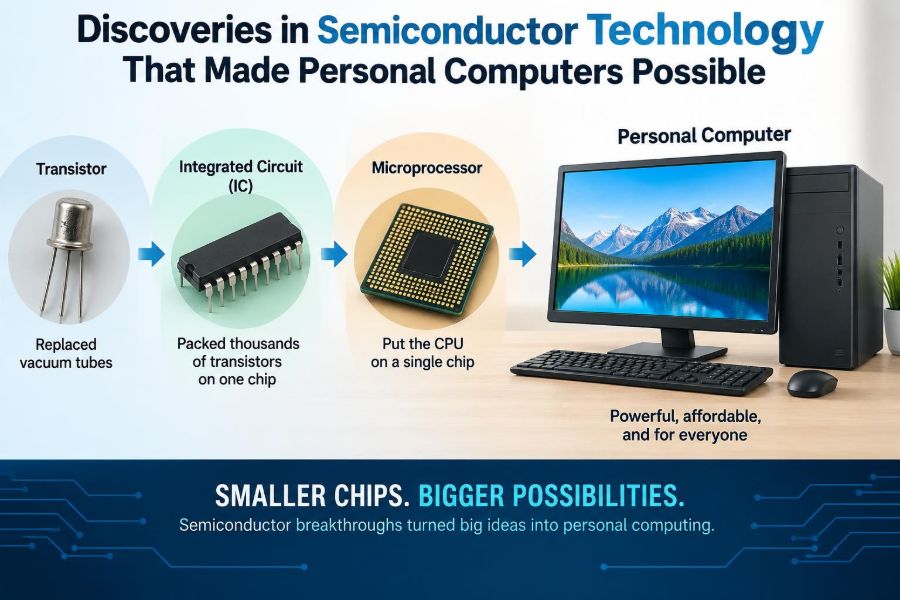
The transistor was demonstrated in the late 1940s as a semiconductor device capable of amplifying or switching signals. Its importance is hard to overstate: it could perform electronic control without the glowing heated elements used in vacuum tubes.
Vacuum tubes helped make early electronic computers possible, but they consumed substantial power, produced heat, and eventually failed. Transistors were smaller, more durable, and more efficient, opening a realistic path toward compact electronics.
🌡️ Why Vacuum Tubes Limited Early Computers
Vacuum-tube computers could be powerful for their time, but a large system needed many tubes, wiring connections, and cooling arrangements. More components also meant more possible failure points.
Transistors did not instantly make computers personal. Early transistorized machines were still expensive and complicated. But replacing bulky, heat-producing switching elements with solid-state devices removed a major physical barrier to miniaturization.
🚪 The Transistor as an Electronic Gate
A transistor can use a small input signal to control a larger current. In digital electronics, this lets it act as a switch: one electrical condition can permit or block another.
Combine switches in carefully designed patterns and they form logic gates. An AND gate, for example, produces an output only when its required inputs are present. Other combinations perform NOT, OR, comparison, addition, and decision-making operations.
A processor is not one giant switch. It is an organized system of enormous numbers of switches working in timed sequences.
🧩 From Individual Parts to Integrated Circuits
Early transistor circuits still required engineers to connect separate transistors, resistors, capacitors, and wires by hand or with assembly methods. As circuit complexity grew, this approach became costly and error-prone.
The integrated circuit, or IC, placed multiple electronic components onto a single piece of semiconductor material. This reduced physical size and shortened many electrical connections, improving reliability and enabling more complex designs.
🏭 The Planar Process Makes Chips Manufacturable
Making one transistor is different from making millions or billions consistently. The planar process provided a practical way to build devices in layers on the flat surface of a silicon wafer.
It uses protective oxide, patterned regions, and controlled material changes to create many components at once. This manufacturing approach made integration scalable rather than a laboratory novelty.
📷 Photolithography Draws Circuits with Light
Photolithography transfers patterns onto a wafer using light-sensitive material and a patterned mask. In broad terms, it resembles using a stencil, except the patterns are extremely small and the process is repeated across many layers.
After exposure and development, selected regions can be etched, doped, or coated. Modern chip production uses advanced optical and other techniques, but the core idea remains: build precise structures by repeatedly patterning layers.
This is why a chip is often described as “printed,” although it is not printed like ink on paper.
🪟 The MOSFET Changes the Scale of Computing
The metal-oxide-semiconductor field-effect transistor, usually called a MOSFET, became the dominant transistor type for digital circuits. Its gate is separated from the semiconductor by a thin insulating layer, allowing an electric field to control current.
MOSFETs can be made very small and arranged densely. Their structure also supports efficient switching, which made them especially suitable for the vast logic and memory circuits needed in personal computers.
🔄 CMOS Reduces Wasted Power
Most modern digital chips use complementary metal-oxide-semiconductor, or CMOS, technology. CMOS pairs transistor types so that, in an ideal steady logic state, there is very little direct current flowing from power to ground.
Real chips still consume power because transistors switch, wires charge and discharge, and leakage occurs. Even so, CMOS made dense digital circuits far more practical than approaches that continuously wasted large amounts of energy.
📦 Packaging Turns a Fragile Die into a Usable Part
The patterned silicon piece inside a chip is called a die. It is delicate and has tiny contact points, so it needs packaging before it can be installed in a computer.
A package protects the die, connects it to the circuit board, and helps move heat away. The familiar processor package is therefore not the processor itself alone; it is a carefully engineered interface between microscopic structures and the rest of the machine.
🧠 Memory Chips Make Programs Practical
A processor can execute instructions, but a useful computer needs places to hold instructions and data. Semiconductor memory made this possible at scales and speeds suitable for general-purpose machines.
RAM, or random-access memory, holds data that the computer is actively using. It is usually volatile, meaning its contents disappear when power is removed. Other semiconductor memory types can retain information without power and are used in firmware and solid-state storage.
🗃️ Logic, Memory, and Storage Are Different Jobs
These terms are often mixed together, but they describe distinct functions. A CPU performs general processing; RAM provides fast temporary workspace; long-term storage keeps files and software when the machine is off.
| Component role | Main purpose | Everyday analogy |
|---|---|---|
| Processor | Executes instructions and calculations | A worker performing tasks |
| RAM | Holds active data temporarily | A desk workspace |
| Storage | Retains files over time | A filing cabinet |
Semiconductor advances improved all three, but not in identical ways. A fast processor cannot compensate fully for too little memory, and abundant storage does not replace working memory.
🧮 The Microprocessor Puts a CPU on One Chip
An early computer CPU could occupy multiple circuit boards filled with integrated circuits. The microprocessor concentrated the central processing functions onto a single chip.
This was a decisive step toward personal computers. Manufacturers could design smaller systems with fewer interconnections, while software could target a standardized processor family instead of a custom collection of boards.
💻 Why Integration Lowered the Barrier to Personal Computers
Integration reduced more than physical dimensions. Fewer separate components generally meant less assembly, fewer wiring points, lower power needs, and more repeatable manufacturing.
Those changes helped make computers affordable enough for homes, schools, and small businesses over time. “Personal” did not mean inexpensive from the beginning; it meant a computer could become small, reliable, and manageable enough for an individual user.
📈 Scaling Packs More Functions into Less Space
Scaling means shrinking device features so more transistors can fit into a given chip area. Shorter paths can also reduce the distance signals travel, which can support faster operation.
For decades, scaling brought a valuable combination of greater capability, lower cost per function, and improved energy efficiency. This trend supported the rapid evolution from simple home computers to systems able to edit video, run simulations, and support rich graphical interfaces.
📏 Moore’s Law Was an Observation, Not a Physical Law
Moore’s Law is commonly used to describe the historical trend of increasing transistor counts on economically produced chips. It guided expectations and industry planning, but it is not a law of nature that guarantees a fixed schedule of progress.
As features approach extremely small dimensions, fabrication becomes harder and more expensive. The lesson is not that progress has stopped, but that progress increasingly comes from several approaches rather than simple shrinking alone.
🔥 Heat Becomes a Design Constraint
Every switching event uses energy, and much of that energy ultimately becomes heat. A chip that generates more heat than its cooling system can remove may slow itself down, become unstable, or suffer reduced lifespan.
This is why processor performance cannot be understood by clock speed alone. A design that completes more work per clock cycle, uses power efficiently, and stays within thermal limits can outperform a faster-clocked but less efficient design.
🧵 Tiny Wires Can Become Bottlenecks
Transistors are not the only structures on a chip. Metal interconnects carry signals and power between them. As chips become more complex, delays and energy losses in these connections can matter as much as transistor switching.
Modern processors therefore use many layers of interconnects, carefully planned layouts, caches, and specialized blocks. A computer’s speed depends on moving data efficiently, not just on performing arithmetic quickly.
🗺️ Chip Architecture Uses Transistors Intelligently
More transistors create possibilities, not automatic speed. Architecture is the high-level organization that determines how a processor fetches instructions, predicts branches, stores frequently used data, and coordinates computing units.
For example, cache memory keeps commonly needed data near processing cores. This can avoid waiting for slower main memory. The practical gain comes from matching hardware organization to real workloads.
👥 Multi-Core Processors Change the Strategy
When raising clock speeds became increasingly limited by power and heat, chip designers expanded capability by placing multiple processing cores on one die. A multi-core processor can work on more than one task or part of a task at once.
The benefit depends on software. A program must be designed to divide work safely and efficiently. Video rendering and scientific calculations often parallelize well; a task with strict step-by-step dependencies may not.
🎯 Specialized Chips Complement the CPU
Personal computers increasingly use specialized semiconductor blocks for graphics, media encoding, security, networking, and machine-learning workloads. A graphics processing unit, or GPU, is well suited to performing many similar operations in parallel.
Specialization can improve speed and energy use, but it also makes hardware and software design more complex. The general-purpose CPU remains essential because it handles the wide variety of instructions and control decisions that specialized units do not.
🔌 Semiconductor Progress Reaches Beyond the Processor
A PC depends on chips in far more places than the CPU. Controllers manage USB connections, wireless communication, audio, power delivery, display output, storage, and system startup.
This wider ecosystem matters in troubleshooting. A computer that fails to charge, loses Wi-Fi, or cannot detect a drive may have a problem in a controller, cable, firmware setting, or power circuit rather than in the main processor.
🧰 Practical Ways to Read PC Specifications
When comparing computers, avoid treating one number as a complete measure of quality. A processor name, core count, RAM capacity, storage type, graphics capability, display, cooling design, and battery or power limits all affect the experience.
- For web browsing and office work, adequate RAM and a responsive solid-state drive often matter more than premium graphics hardware.
- For programming, design, or large spreadsheets, extra memory can prevent slowdowns caused by frequent data swapping to storage.
- For gaming or 3D work, GPU performance and cooling are often as significant as the CPU.
- For compact laptops, sustained performance may be lower than brief benchmark performance because of heat and power limits.
The best choice is the machine whose semiconductor resources fit the tasks you actually perform.
⚠️ Common Misunderstandings About Chips
One common mistake is assuming a smaller manufacturing “node” automatically makes every chip faster. Node names are industry labels, and comparisons across manufacturers are not always direct. Design, power targets, memory, and software all matter.
Another is treating transistor count as a score. More transistors may support larger caches, more cores, or new features, but their value depends on how they are used. A well-balanced system often matters more than an impressive single specification.
🏗️ Why Chip Manufacturing Is So Demanding
Chip fabrication requires exceptionally clean environments because a tiny particle can damage patterns on a wafer. It also requires precise equipment, specialized chemicals, controlled temperatures, and extensive testing.
Yield is a practical concern: not every die produced on a wafer will meet the required standard. Larger or more complex chips can be harder to produce economically because there is more area in which a defect may occur.
♻️ Efficiency Matters Alongside Performance
More capable computing has real energy and material costs. Efficient chips can extend laptop battery life, reduce cooling requirements, and lower electricity use in large computing installations.
Efficiency is not only a hardware issue. Software that avoids unnecessary background work, uses suitable algorithms, and takes advantage of available hardware can reduce wasted processing. Keeping a useful computer in service longer through repair or upgrades can also reduce premature replacement.
🔮 New Packaging Extends Progress
Rather than placing every function on one enormous die, designers can combine smaller dies in advanced packages. These are often called chiplets. High-speed connections let the pieces work together as a system.
Three-dimensional stacking is another approach, placing some components vertically to shorten connections or add dense memory. These techniques offer new options, though they introduce challenges involving heat, testing, cost, and design complexity.
🌍 Semiconductor Technology Shapes Everyday Computing
The semiconductor is not merely a component hidden inside a device. Its development determined what kind of computing could exist: portable, interactive, networked, graphical, and available to individuals rather than only institutions.
Each major discovery solved a specific limitation. Controllable p–n junctions enabled useful devices; transistors replaced tubes; integrated circuits reduced complexity; MOSFETs and CMOS enabled density and efficiency; microprocessors concentrated computing power; advanced manufacturing kept increasing capability.
✅ The Core Takeaway: Controlled Miniaturization Creates Capability
The central principle behind the personal computer is not simply “smaller is better.” It is controlled miniaturization: creating huge numbers of reliable switches, memory cells, and connections with predictable behavior, then organizing them into a useful system.
That principle explains both the achievements and the limits of modern computing. Semiconductor technology made personal computers possible by making electronic logic compact and affordable enough to use widely. Continuing progress now depends on better materials, architecture, packaging, software, and energy management—not on one breakthrough alone.
From the p–n junction to the multi-core processor, semiconductor discoveries turned controlled electrical behavior into the personal computing tools people rely on every day. 🖥️🔬⚡